Tuesday, 21 November 2017

WW1 Memorial Quilt – Jack

On Armistice weekend - It seemed suitable to start on another piece of my memorial quilt – so I designed and started knitting this piece.


Rowan Felted Tweed

This design is called Jack and it represents the unknown.  I do not know the occupation of a number of my soldiers.  I can’t find their enlistment records and in 1911 they were “At School”. 
The design for this piece is based on the Thiepval Memorial. I know – you can’t see it!  I had intended to produce a repeat pattern inspired by the shape of the memorial – however – I own a book called The Memorial to the Missing of the Somme by Gavin Stamp – in which there is a “floor” plan of the memorial and when I saw it I knew immediately – I am going to knit something like that.

knitted memorial

I wanted to use the Thiepval Memorial for inspiration for soldiers of unknown occupation because it commemorates the unknown – the missing – the soldiers with no known burial site.  I have called it Jack for a special reason.  It is named after my grandfather’s cousin John Harris.   He was a rifleman in the 12th battalion of the Rifle Brigade and died on 8 September 1916 aged 19.  What is strange about him is that I made him up and then found out he existed!
My grandfather said that his aunt and uncle did not have any children.  I thought this was unusual and one day I started thinking that if they had a son he would have been called John or Jack  Harris after his dad and he would have been born a year or so after the marriage – which would have made him the ideal age to die in World War 1.  I looked at the War Graves Commission website and typed in the name John Harris.  There are 700 men called John Harris who died but he was the third one I looked at – and I knew it was right because the record gave the name and address of his parents. 
Jack obviously wanted to be remembered after having been forgotten in the family for the best part of 80 years.  So this piece is for Jack and for all the other young men who died including another cousin twice removed - Frank Hatcher who died on 9 September 1918 aged 20, James William Merryweather my third cousin twice removed who died on 24 September 1917 aged 19, my third cousin three times removed Frederick Samuel Read who died on 16 June 1915 aged 19, and Lawrence Dimmick Willmett my second cousin three times removed who died aged 19 on 11 December 1917.  The latter was in the Royal Army Medical Corps – so he may have had a medical occupation but I don’t know what it was.


There are 2 other soldiers whom I should mention by name who are both recorded on the real Thiepval Memorial – Archibald Francis Jones who was my third cousin twice removed and John Deal who was my fourth cousin twice removed.  They both died aged 19.
For a blog about knitting – this post seems to be full of soldiers.  The knitting itself was very straightforward.   I used mainly stone colours to represent the memorial – but added the orange for a bit of contrast.  If you didn’t know the story behind the piece – it just looks like a graphic pattern.  That is the effect I wanted.


I am now working on the next piece and it is almost finished.  It was a much simpler pattern and much more portable.

Saturday, 11 November 2017

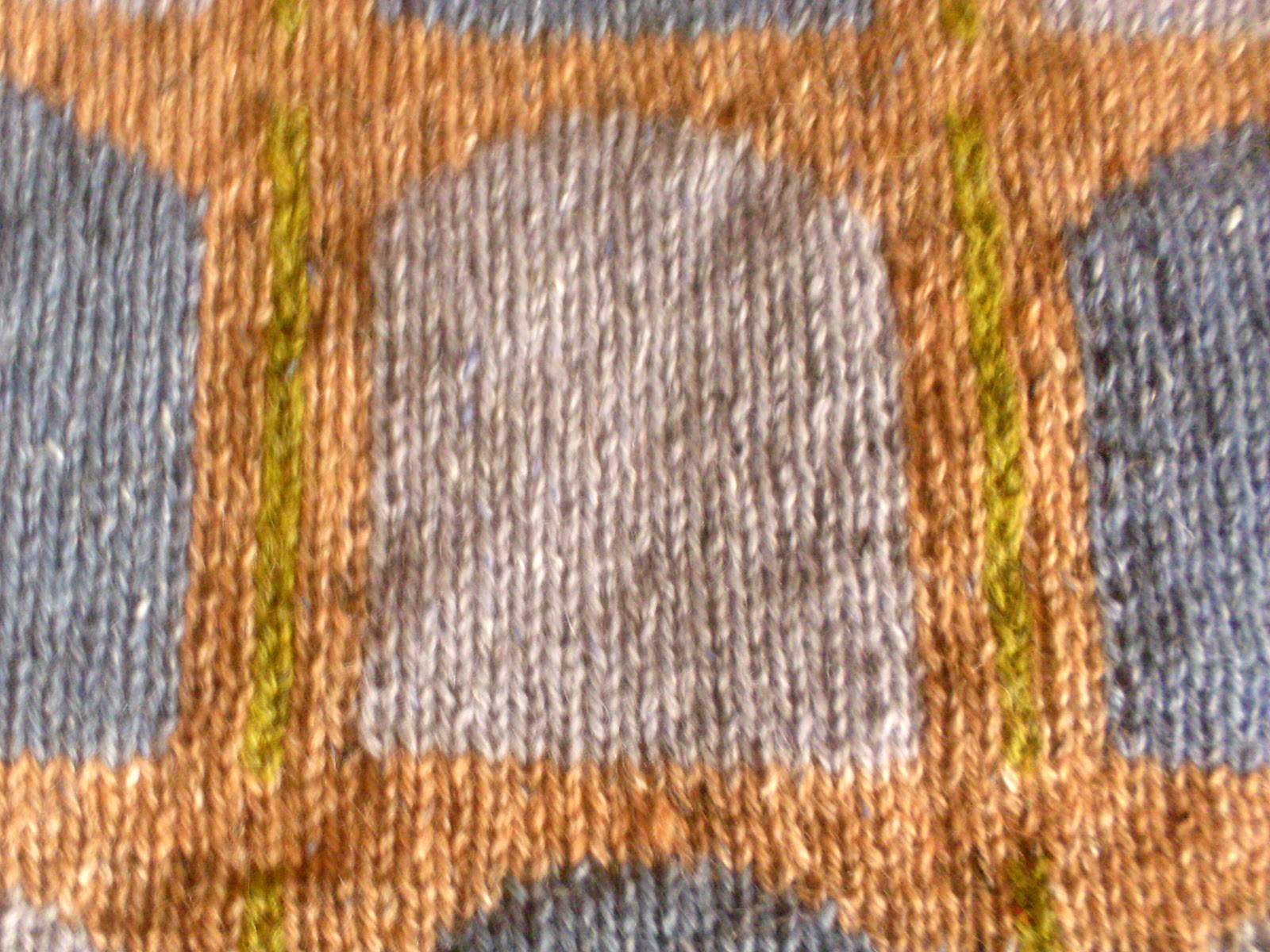
WW 1 Memorial Quilt – Tom

It seemed appropriate this week that I would knit a piece for my great grandfather Thomas Wade who died in 1917.  I know I have mentioned him in previous years.  He didn’t want to fight – he wanted to stay at home with his family.  In the event – he was killed and his widow had to struggle to bring up his 3 sons.


Rowan Felted Tweed

Thomas was a glass fitter.  My grandfather said he was a cabinet maker, but on the 2 occasions when he gave his occupation - in 1909 when he married and on the 1911 census – he said he was a glass fitter.  I think he fitted glass in cabinets.  I always knew I would do a glass inspired piece of knitting for Tom.

This is very similar to the design for the tea packer which means that the arched shapes will be carried across the quilt. For this piece I cast on 79sts.  I had originally intended to do 80, but the design works better with an odd number of stitches and I have just altered the surrounding pieces accordingly.  This piece is 132 rows long.
I was just going to use blue and brown yarn but I decided to add the lime green for a bit of interest. Each blue arch shape is 15sts wide and 24 rows to the shaping (29 rows in total).  There are 2 rows at the bottom and top and 4 rows between shapes.  Across the row there are 5sts between the arches with one lime stitch in the centre.  There are 2sts each side of each row.  If you want to knit one – just draw the set-up on graph paper (or the back of an envelope) – that’s what I did.


I was thinking – you might not want to knit a memorial quilt but you could knit a quilt like this for another reason – eg you could do one for your family with a different piece of knitting to represent each person – or you could do one for a special person with each piece representing an important part of their life – or you could knit a quilt  for your community with each piece representing something important in your town or village. If I had enough old photos I would combine knitting with using photo transfer paste to produce a knitted family tree.  That’s enough mad ideas for this week…

Wednesday, 8 November 2017

WW1 Memorial Quilt - Horace

While I was away at my Mother’s last week – I knitted the next piece of my memorial quilt.


This piece is called Horace after Horace Edwin Willmett who was my second cousin, three times removed.  He was a private in the 7th battalion of the Queen’s Royal West Surrey Regiment who died on 7 March 1917 aged 26.  In civilian life he was a printer. 
The husband of my third cousin twice removed: Robert Bramall Dives also died in 1917 on 28 February.  He was a gunner in the Royal Garrison Artillery but in civilian life he was a compositor.

I nearly forgot to mention another printer – my third cousin three times removed – Henry George Cann who was in the Rifle Brigade.  He died on 30 June 1916 aged 32.  He is a recently discovered member of my family tree.
This was probably one of the easiest designs to think of and to knit.  It was obvious to choose words for a printer.  For this piece I cast on 134sts and worked 99 rows in stocking stitch.


I decided to use the trades and to knit them using the fair-isle technique.  I tried to use light colours with a dark background and dark colours with a light background. Some of them stand out better than others.  In the photos some are hard to read – eg Fireman – but it is not too bad in real life.  Also the end of Clerk looks a bit odd because of the flecks in the yarn.  I have done it right – but the K looks a bit warped.


Over the years, I have knitted lots of tea cosies with slogans on – so this idea was just an extension of that.  I hope I haven’t spelt anything wrong!  Once the letters are set up correctly they are fairly easy to knit.  When I was designing the pattern – I had to write the words on graph paper and then cut them out and stick them onto the blank pattern piece.  I couldn’t just mark them straight onto the pattern as I didn’t know how much space they would take up until I had written them (if you see what I mean).  I could have written them again instead of using glue but I am lazy! 
I also admit – that I have not exactly stuck to the pattern – sometimes I have started the words in a slightly different place – but it doesn’t matter.

I am now knitting the next piece. 

Thursday, 26 October 2017

WW1 Memorial Quilt – Arthur

This week I have been knitting a filing cabinet!  There are a lot of knitting blogs out there but I doubt if any of the others contain that line. 


This is the next piece of my knitted quilt.  It is to remember several of my relatives who died in World War 1, but it is named after my third cousin twice removed – Arthur Edward Jones who was a Lance Corporal in the 6th battalion of the Duke of Cornwall’s Light Infantry.  He was killed on 30 July 1915 aged 26.  Arthur was a clerk.  His brother and brother-in-law were also killed during the war.
My second cousin three times removed John Frederick Stenner was also killed. He was in the Grenadier Guards and was killed on 2 Oct 1916.  He was only 19 when he died but he had done office work as a young boy in 1911.  His cousin Edward Henry Stenner (who is also my second cousin three times removed was also in the Grenadier Guards and a clerk in civilian life.  He died on Christmas Eve 1914.
I don’t know what the occupation of “clerk” suggests to you – perhaps piles of paper, but I thought of a filing cabinet.  I am not exactly sure what a contemporary filing cabinet would have looked like – I looked at a few antiques online – and it seems it is likely to have been made of wood – so I decided to use brown yarn.


Originally I had thought of green.  I have an old green metal filing cabinet – but I think it is only about 50 years old rather than 100.  I think I will be using green yarn for other occupations – such as labourer and gardener – so I decided on brown for this piece.

For Arthur I cast on 67sts using my main colour  Shade 145 and then knitted 6 rows in the darker brown  Shade 169.  I used red – Shade 150 to outline the drawers which are knitted in light brown – Shade 157. The handles are the main shade again – and I used Shade 177 for the labels.  I knitted three columns of 4 drawers with 2 rows of the darker brown between each row, 2 sts each side and 3 sts between the drawers. There are 99 rows in total.  This is exactly the same size as Caleb – the first piece I knitted and at the moment – I intend them to be placed at opposite corners at the bottom of the quilt.
I drew the design on graph paper but once I had done the set up row to get the first row of drawers in the right place – I did not really need to refer to the diagram.
Now I am going to start knitting a piece to remember the printers and compositors in my family. 

Friday, 20 October 2017

Free Your Fade

Free Your Fade is the latest design by Andrea Mowry of DreaReneeKnits.com.  A couple of weeks ago I received a copy of the Tangled Yarn newsletter and it advertised this shawl as well as a variation on the Hitchhiker pattern – Hitchhiker Beyond.  I ordered both immediately and started knitting this shawl as soon as the pattern arrived.


I think I have almost finished it.  At least I haven’t got much yarn left so it will have to be nearly finished!  You are encouraged to use any yarn of any thickness. 

I have used 2 balls of Debbie Bliss Rialto Luxury Sock yarn in Shade 04.  The idea of the shawl is to change from one colour to another whenever you like.  The pattern describes two colours changes.  I have knitted it in one shade but have changed balls following the pattern – so I have two colour changes, but my colour changes are very subtle.


When I started knitting this shawl – I took it out 3 times until I got the hang of the pattern.  It is me – the pattern is excellent.  I was tempted by the previous design called Find Your Fade shawl – but decided it is a bit too big – this one is a more manageable size – both to knit and to wear.  I may have a go at Find Your Fade but make it smaller.  I thoroughly recommend Free Your Fade to all shawl fans.
I am now going to get back to the serious stuff.  I have started knitting the next piece of my Memorial Quilt.

Tuesday, 10 October 2017

WW1 Memorial Quilt – Fred – Finished Piece

I have finished my second piece – I told you it was easy!


This piece is called Fred and is based on the occupation of tea packer.  A rough pattern is given below.
I used brown (Rowan Felted Tweed Shade 145)for the background and 15 other shades (from the top left to right  158, 150, 181, 151, 157, Mink, 154, 184, 159, 177, 192, 186, 175, 161, 195)  I used separate balls of each colour – winding 3 balls of brown.
Using 4mm needles I cast on 67sts and knit 165 rows.  I knit 2 rows in brown and then did a “set-up” row to place the colours as follows: K7 in brown, K9 in first shade, K15 in brown, K9 in second shade, K15 in brown, K9 in third shade, K2 in brown.  For the next 4 rows I decreased the brown by one st and increased the colours correspondingly until I had 2sts in brown, 19sts in Shade 1, 3sts in brown, 19sts in  Shade 2, 3sts in brown, 19sts in Shade 3 and 2sts in brown.  I worked 18 more rows straight – so you have 19 rows without “shaping”.  I then reversed the procedure I had used at the bottom to reduce the coloured sections down to 9sts again.  I then worked 4 rows in brown, and started the with 3 new colours and so on.  When I had completed the 165th row, I cast off in brown.
If you want to try it – it may be best to draw it on graph paper first.  As with the first piece – the pattern sounds much more complicated than it actually is.
While I have been knitting this piece – I have been thinking about patterns for some of the other pieces.  I am going to start another piece this week but at the moment I am knitting a shawl.

Wednesday, 4 October 2017

WW1 Memorial Quilt – Fred


Rowan Felted Tweed

I have started working on a second piece of my knitted patchwork quilt.    I am calling it Fred after Frederick Charles Connew who was my third cousin twice removed. He was a private in the 2nd Battalion of the Leicestershire Regiment who died on 25 September 1915 aged 21.  
According to the 1911 census Frederick was a tea packer working for a tea merchant – presumably in London where he lived.  I think this could have been quite dangerous work, as tea can be explosive if it forms a dust cloud.  The design I have come up with for this piece is based on the tops of tea chests.
Rowan Felted Tweed

Originally I intended to do columns of 4 shapes – but now I have decided to do 3 columns of 5 shapes – this means that this piece uses 16 different shades of Rowan Felted Tweed but it could be knitted with just 2 one for the “centres” and one for the background.  I have used my main colour – brown for the background.


This piece is knitting up very quickly.  I think there are 2 reasons for this – firstly it is quite interesting to knit and secondly because  it is easier to knit than the first piece - the yarn does not get so tangled.