Wednesday, 27 December 2017

A Cat Cardigan

I offered to make a cardigan with a cat on for the 4 year-old niece of a friend of mine.  I thought it would be appropriate to use her cat as inspiration, so I asked for some photos.  This is Cheeky sitting on the draining board.


As you can see this cat has very distinctive facial markings.  I hope I can do something similar in yarn.  So far I have knitted the front which has very little cat on it.


The cat is on one front and its tail goes around the neck and the end appears on the other front.  My friend had trouble getting the cat to sit still and some of the more blurred photos show him in almost the correct position –so that I can see how the white and black appears on his back.  The design is loosely based on an old pattern that I have got with a cat in the pocket of a cardigan, but that only includes the head, paws and tail of the cat – and looks a bit odd.  I have decided to include more of the cat.
I haven’t got much knitting done over Christmas but I have knitted quite a lot of one of the sleeves because that was fairly easy to do.  I need to be fresh and alert when I tackle the cat so I probably won’t get on to that until next week.

Tuesday, 19 December 2017

WW1 Memorial Quilt – Bob

I have sorted out my piece of knitting which represents the tailors and drapers in my family who died in World War 1.


In the end I had to make it 24 rows shorter.  This seems a lot but it is now roughly the right size.
This piece is for Robert Henry Chant who was the husband of my third cousin twice removed.  He was a gunner in the Royal Garrison Artillery who died in Salonika on 19 Dec 1917 – exactly 100 years ago today.  It is also for my fourth cousin, twice removed Harold Farley Carver who was a private in the Duke of Cornwall’s Light Infantry and who died on 3 Mar 1916 aged 26.  Harold was a tailor in civilian life and Robert was a Drapery warehouseman.

Originally I had thought about doing a design which showed some “fans” of fabric – like those you used to see in shop windows, but I couldn’t make them look right – so I thought about actually knitting some fabric – and decided on dogs-tooth check.  The red bits are supposed to represent stitches.

I cast on 79sts and repeated the 4 row pattern 12 times.  I then knit 12 rows including the red “stitches”, and then repeated the 4 row pattern a further 12 times.  I used Rowan Felted Tweed DK Shade 153 (A) and  Shade 157 (B).  The red is Shade 150.

The 4 Row pattern is:
Row 1:* K1A, K1B, K2A; repeat from *  to last 3 sts, K1A, K1B, K1A.
Row 2:* P2B, P1A, P1B; repeat from *  to last 3 sts, P2B, P1A.
Row 3:* K3B, K1A; repeat from *  to last 3 sts, K3B.
Row 4:* P1B, P3A; repeat from *  to last 3 sts, P1B, P2A.

I hope that is right – basically on each row you knit or purl one stitch in one colour and then 3 in the other.
I am now going to make a cardigan with a cat on for the niece/grand-daughter of some friends of mine, but I have an idea for the next piece of the memorial quilt and I will get back to it in the new year.

Thursday, 14 December 2017

WW1 Memorial Quilt - Charlie

This piece of my WW1 memorial quilt represents the occupation of a butcher.


It has turned out quite well – just as I envisioned it in my head.  I am not sure that butchers wore blue striped aprons in the early part of the twentieth century  –  the stripes may have been red.  I have looked at lots of old photographs but of course – they are in black and white. 

When I was thinking about what to knit for a butcher – I thought of lots of gruesome things which seemed inappropriate.  A clean apron seemed a bit odd – but I resisted the temptation to add blood stains and included a poppy instead!

knitted poppies

This particular poppy is similar to one that adorns the front cover of a book I own called Banbury During the Great War by Kevin Northover.  Normally my knitted poppies are one shade of red and have a black centre but the one on this book cover has a green centre and the petals appear to be different colours due to the reflection of the light.

For this piece of knitting I cast on 95sts and worked 66 rows.  It is exactly the same size a the piece I did for the postmen.  I mainly used Shade 178 of Rowan Felted Tweed. 
Although many members of my family were butchers – at the moment – I only know of one soldier who died during World War 1 who was a butcher and that is my second cousin twice removed: Charles Richard Carswell who was a private in the 17th Welsh battalion.  He died on 31 December 1916 aged 25.  He is remembered on the war memorial of his home village of Elham in Kent and on the Thiepval memorial.

I am now trying to fix “Bob” - my piece of knitting which represents tailors and drapers.  I have checked and it needs to be the same size as Tom – the piece for glass fitters – so I have unravelled some of it and am reknitting it shorter.

Wednesday, 6 December 2017

WW1 Memorial Quilt

As I said at the end of my last post – I have started knitting a piece to remember the tailors and other textile workers in my family. 


When I say I have started it – I had hoped I had finished it – but something has gone wrong and it is too long – so I will probably need to unravel some of it and make some adjustments.

When I started this project and drew out a plan of how many pieces I was going to knit and how many rows and stitches each one needed.  I was a bit worried that this piece would be too narrow if I pulled the threads too tight across the back – but the width is OK – it is the length.  This piece which will be known as Bob should be the same size as Tom and it isn’t!  Never mind – I can fix it!
Before I make adjustments to this piece – I am going to knit the next piece.  Because that will confirm how long it needs to be.  So I will come back to Bob.  I have made a start on Charlie – the piece for a butcher.

On Saturday I went to Oxford for the monthly Knitting and Crochet Guild meeting.  It was a Show and Tell session – so I took the pieces of quilt that I have done so far.  I have told several people about the project but I don’t think they understood it until they actually saw what I was doing.  I am now going to do a talk about it in June next year.  As a member of the Birmingham group was present – I am also going to talk about it in Birmingham next August. 

Before I went to the meeting, I visited Oxford Yarn Store to buy some more yarn – and everyone there seemed to like the pieces of quilt and were interested in the idea behind it.  With all this interest I had better get on with it.  However, I think I may have to fit in a last minute Christmas present before I can concentrate all my attention on it.

Monday, 27 November 2017

WW1 Memorial Quilt – George

I am on a roll at the moment.  I think I was inspired by Armistice Day to put more effort into this project.

Rowan Felted Tweed

This piece is called George and I hope it is obvious what the occupation is – it is a letter to represent a postman.
This piece was named after George Skeer who was the husband of my 4th cousin twice removed.  George was a postman but he became a sergeant in the Royal Garrison Artillery and died on 21 March 1918 aged 37.   This piece is also for my 2nd cousin, three times removed - Francis Reginald Wade who was a rifleman in the 8th battalion of the London Regiment (the Post Office Rifles).  He died on 24 July 1915 aged 24.


When I was thinking about what to knit for a postman – I did consider a pillar box, but I like the simplicity of a letter.  It is a bit of an odd shape – but at least it is not tall and narrow.  I chose the most “letter-like” shape for the postmen.  It is the second time this year that I have knitted words as blocks of colour – or in this case – blocks of grey.  I may embroider on some franking across the stamp.
This piece is 95sts wide and 66 rows high.  I mainly used Rowan Felted Tweed Shade: 177.
I am now working on a piece for a tailor and draper.

Tuesday, 21 November 2017

WW1 Memorial Quilt – Jack

On Armistice weekend - It seemed suitable to start on another piece of my memorial quilt – so I designed and started knitting this piece.


Rowan Felted Tweed

This design is called Jack and it represents the unknown.  I do not know the occupation of a number of my soldiers.  I can’t find their enlistment records and in 1911 they were “At School”. 
The design for this piece is based on the Thiepval Memorial. I know – you can’t see it!  I had intended to produce a repeat pattern inspired by the shape of the memorial – however – I own a book called The Memorial to the Missing of the Somme by Gavin Stamp – in which there is a “floor” plan of the memorial and when I saw it I knew immediately – I am going to knit something like that.

knitted memorial

I wanted to use the Thiepval Memorial for inspiration for soldiers of unknown occupation because it commemorates the unknown – the missing – the soldiers with no known burial site.  I have called it Jack for a special reason.  It is named after my grandfather’s cousin John Harris.   He was a rifleman in the 12th battalion of the Rifle Brigade and died on 8 September 1916 aged 19.  What is strange about him is that I made him up and then found out he existed!
My grandfather said that his aunt and uncle did not have any children.  I thought this was unusual and one day I started thinking that if they had a son he would have been called John or Jack  Harris after his dad and he would have been born a year or so after the marriage – which would have made him the ideal age to die in World War 1.  I looked at the War Graves Commission website and typed in the name John Harris.  There are 700 men called John Harris who died but he was the third one I looked at – and I knew it was right because the record gave the name and address of his parents. 
Jack obviously wanted to be remembered after having been forgotten in the family for the best part of 80 years.  So this piece is for Jack and for all the other young men who died including another cousin twice removed - Frank Hatcher who died on 9 September 1918 aged 20, James William Merryweather my third cousin twice removed who died on 24 September 1917 aged 19, my third cousin three times removed Frederick Samuel Read who died on 16 June 1915 aged 19, and Lawrence Dimmick Willmett my second cousin three times removed who died aged 19 on 11 December 1917.  The latter was in the Royal Army Medical Corps – so he may have had a medical occupation but I don’t know what it was.


There are 2 other soldiers whom I should mention by name who are both recorded on the real Thiepval Memorial – Archibald Francis Jones who was my third cousin twice removed and John Deal who was my fourth cousin twice removed.  They both died aged 19.
For a blog about knitting – this post seems to be full of soldiers.  The knitting itself was very straightforward.   I used mainly stone colours to represent the memorial – but added the orange for a bit of contrast.  If you didn’t know the story behind the piece – it just looks like a graphic pattern.  That is the effect I wanted.


I am now working on the next piece and it is almost finished.  It was a much simpler pattern and much more portable.

Saturday, 11 November 2017

WW 1 Memorial Quilt – Tom

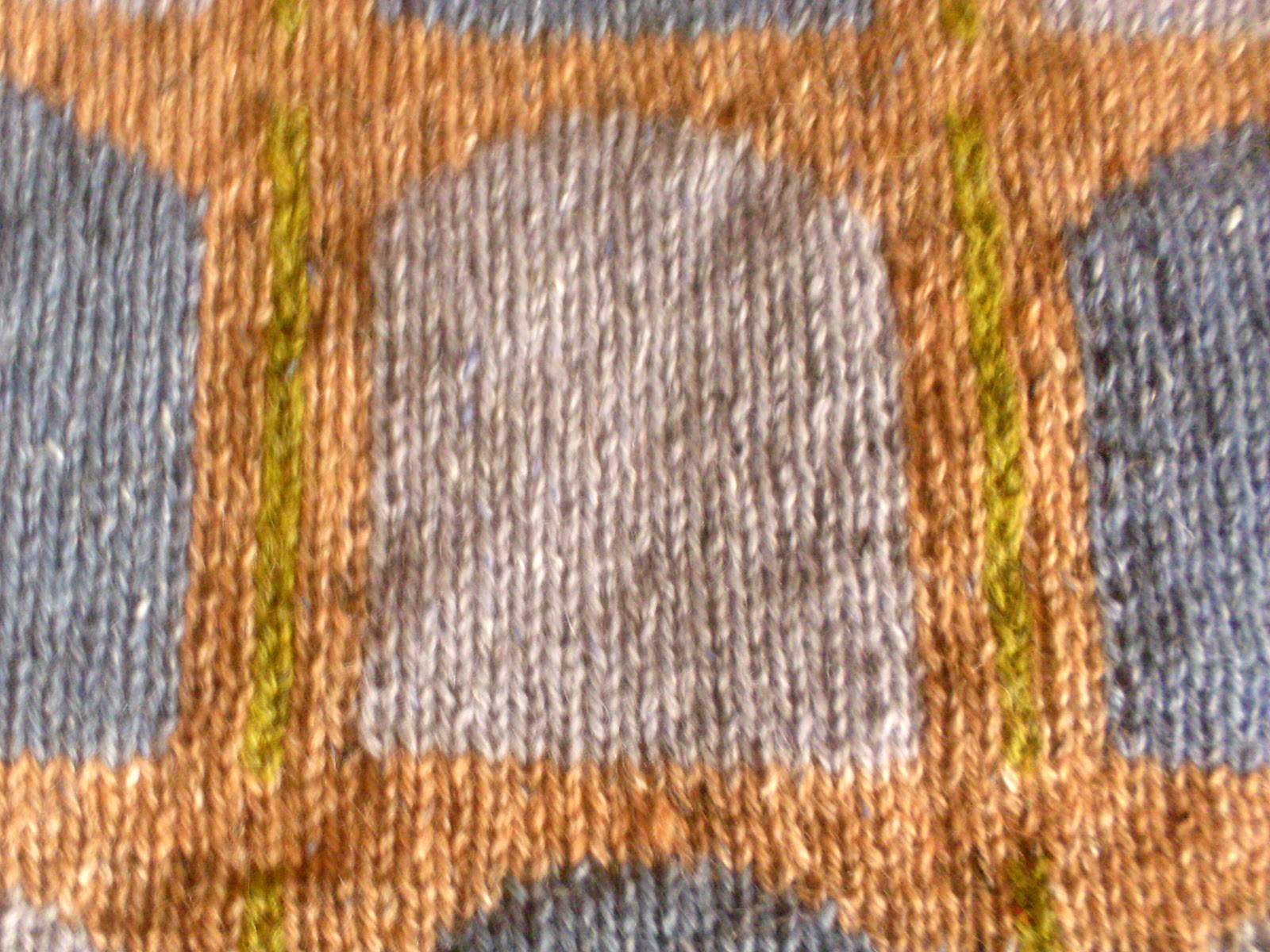
It seemed appropriate this week that I would knit a piece for my great grandfather Thomas Wade who died in 1917.  I know I have mentioned him in previous years.  He didn’t want to fight – he wanted to stay at home with his family.  In the event – he was killed and his widow had to struggle to bring up his 3 sons.


Rowan Felted Tweed

Thomas was a glass fitter.  My grandfather said he was a cabinet maker, but on the 2 occasions when he gave his occupation - in 1909 when he married and on the 1911 census – he said he was a glass fitter.  I think he fitted glass in cabinets.  I always knew I would do a glass inspired piece of knitting for Tom.

This is very similar to the design for the tea packer which means that the arched shapes will be carried across the quilt. For this piece I cast on 79sts.  I had originally intended to do 80, but the design works better with an odd number of stitches and I have just altered the surrounding pieces accordingly.  This piece is 132 rows long.
I was just going to use blue and brown yarn but I decided to add the lime green for a bit of interest. Each blue arch shape is 15sts wide and 24 rows to the shaping (29 rows in total).  There are 2 rows at the bottom and top and 4 rows between shapes.  Across the row there are 5sts between the arches with one lime stitch in the centre.  There are 2sts each side of each row.  If you want to knit one – just draw the set-up on graph paper (or the back of an envelope) – that’s what I did.


I was thinking – you might not want to knit a memorial quilt but you could knit a quilt like this for another reason – eg you could do one for your family with a different piece of knitting to represent each person – or you could do one for a special person with each piece representing an important part of their life – or you could knit a quilt  for your community with each piece representing something important in your town or village. If I had enough old photos I would combine knitting with using photo transfer paste to produce a knitted family tree.  That’s enough mad ideas for this week…