Sunday, 10 August 2014

Second Knitted L-shape Sample

I have had another go at the sample.  This one is much better.   It fits the template jumper better and I like how it looks.


The L-shape has been knitted using 4mm needles and most of the yarn is double knitting or 4 ply used double thickness.  I have decided on a size which is 11 + 1 + 22 + 1 + 22 + 1 + 11 (69 stitches to cast on or pick up).
The details are as follows:
Row 1: With main colour, cast on 69sts.
Row 2: Knit.
Row 3: K10, K3tog, K20, K3tog, K20, K3tog, K10.
Row 4: Purl.
Row 5: Change to main colour and K9, K3tog, K18, K3tog, K18, K3tog, K9.
Row 6: Knit.
Row 7: Change colour and K8, K3tog, K16, K3tog, K16, K3tog, K8.
Row 8: Purl.
Row 9: K7, K3tog, K14, K3tog, K14, K3tog, K7.
Row 10: Purl.
Row 11: Change to main colour and K6, K3tog, K12, K3tog, K12, K3tog, K6.
Row 12: Knit.
Row 13: Change colour and K5, K3tog, K10, K3tog, K10, K3tog, K5.
Row 14: Purl.
Row 15: K4, K3tog, K8, K3tog, K8, K3tog, K4.
Row 16: Purl.
Row 17: Change to main colour and K3, K3tog, K6, K3tog, K6, K3tog, K3.
Row 18: Knit.
Row 19: Change colour and K2, K3tog, K4, K3tog, K4, K3tog, K2.
Row 20: Purl.
Row 21: K1, K3tog, K2, K3tog, K2, K3tog, K1.
Row 22: Purl.
Row 23: Change to main colour and K3tog 3 times.
Row 24: K3tog and fasten off.

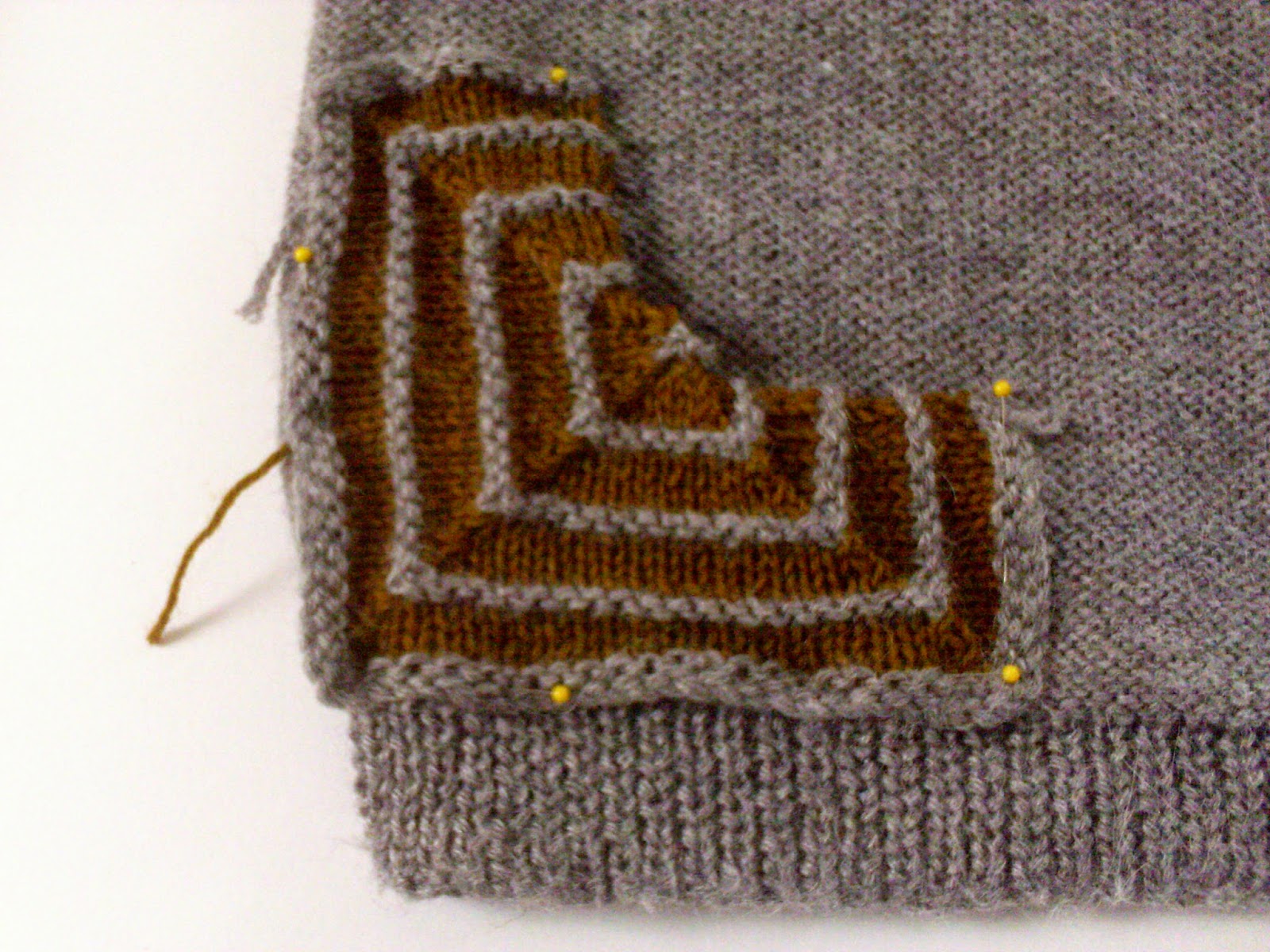
 Unlike other modular knitting which I usually work in vertical strips, I am going to knit all the modules across the bottom of the jumper to make sure that it will fit the template reasonably closely.  I can always change the finished length of the jumper by adding a few more rows or a longer rib.  I could widen the jumper by knitting some side pieces, but I want to avoid that if can.

Saturday, 9 August 2014

First Knitted L-shape Sample

I have knitted my first L-shape sample and used it to work out whether I have got the right size.

 
Unfortunately – it is too large and I don’t like how it looks!  This sample consists of 12 + 1 + 24 + 1 + 24 + 1 + 12 (75 stitches to cast on or pick up).  I have pinned it to my template jumper and have worked out that it is too big.  I am now knitting a sample with fewer stitches: 11 + 1 + 22 + 1 + 22 + 1 + 11 (69 stitches to cast on or pick up).
I am also not keen on how this sample looks – I think if I do each shape with just 2 colours – the finished result will look bitty, so I now intend to use a different colour yarn for each bit of stocking stitch.

Wednesday, 6 August 2014

Yarn for a Modular Knitted Jumper

 
I have collected together various odd balls of mainly grey, green and mauve yarn.  Originally I intended to make a scarf in the style of Sophie Digard.  I crocheted a few shapes and then lost interest – or more likely was asked to knit something as a matter of urgency!
Now that I have realised that at the moment my red L-shaped jumper is too tight, I want to knit another one – and there is enough of this yarn to make a jumper.
If I am not too busy this week I hope to make a start by knitting a few sample modules.

Monday, 4 August 2014

Knitted Poppy Tea Cosy - Version 2

 
This tea cosy was knitted to remember the soldiers lost in the First World War – on both sides – but particularly my great grandfather Thomas Wade who was killed in 1917.
The tea cosy is very simple – a basic green tea cosy with 5 knitted poppies on top.  I have used buttons for the centres to add a bit of texture.
It is likely that I will come up with some more poppy-based designs during the next 4 years!

Tuesday, 29 July 2014


Knitted Poppy Tea Cosy


After a few false starts I have knitted a tea cosy which consists of 3 strips on each side.  I then sewed them together, and added a few rows at the top and bottom to neaten the edges and to get the right length.  I toyed with the idea of a green tab to finish it off, but decided that the pom-pom looks better. 
I had intended to do more strips and more poppies but I think that would be better suited to a complicated fair-isle/intarsia design.  With this design, I quite like the way the whole poppy seems to be at the centre of a cross.
I have thought of 3 other ideas for tea cosies with poppies on and I am now off to cast one on.


Saturday, 19 July 2014

Modular Knitting or Strip Knitting?

In this blog I tend to use the term “modular knitting” to refer to all forms of knitting which involve knitting shapes – squares, oblongs, L-shapes, triangles or even irregular shapes.
Horst Schulz uses the term “patchwork knitting” to describe his modular knitting.  I tend to use this term just for quilts and throws.
Vivian Høxbro uses the term “domino knitting” to describe her modular knitting – but she mainly uses squares and shapes involving squares.
There is another lesser-used term – “strip knitting”.  Much of my modular knitting is really strip knitting.   The photo below shows a commercially bought bag covered in strip knitting.  I was trying to use up very small bits of Fandango yarn – so I knitted very narrow strips.

 
The tea cosy that I am currently working on is an example of strip knitting.  When I say “currently working on” I mean “thinking about” – actually this week I have been knitting a very small jacket for a baby who arrived last weekend.  This afternoon I am going to get on with roughing out a pattern for my tea cosy.

Sunday, 13 July 2014

Modular Knitted Bag’s First Excursion

 
I admit it – this post is just an excuse to show you a photo of the other side of my bag.  I used it yesterday with the green side facing outwards, but today I showed off this other side.
What I like about using Fandango yarn is that the modules and stripes of knitting are not clearly defined – they merge together.  You can achieve a similar effect by felting wool, but it involves a lot more hassle.
Now I am at a loose end – what shall I knit next?  I would like to make a start on a jumper but I think that I had better do something easier.  I may attempt a tea cosy to commemorate the First World War.  I have an idea in my head – I hope I will be able to translate it into knitting.